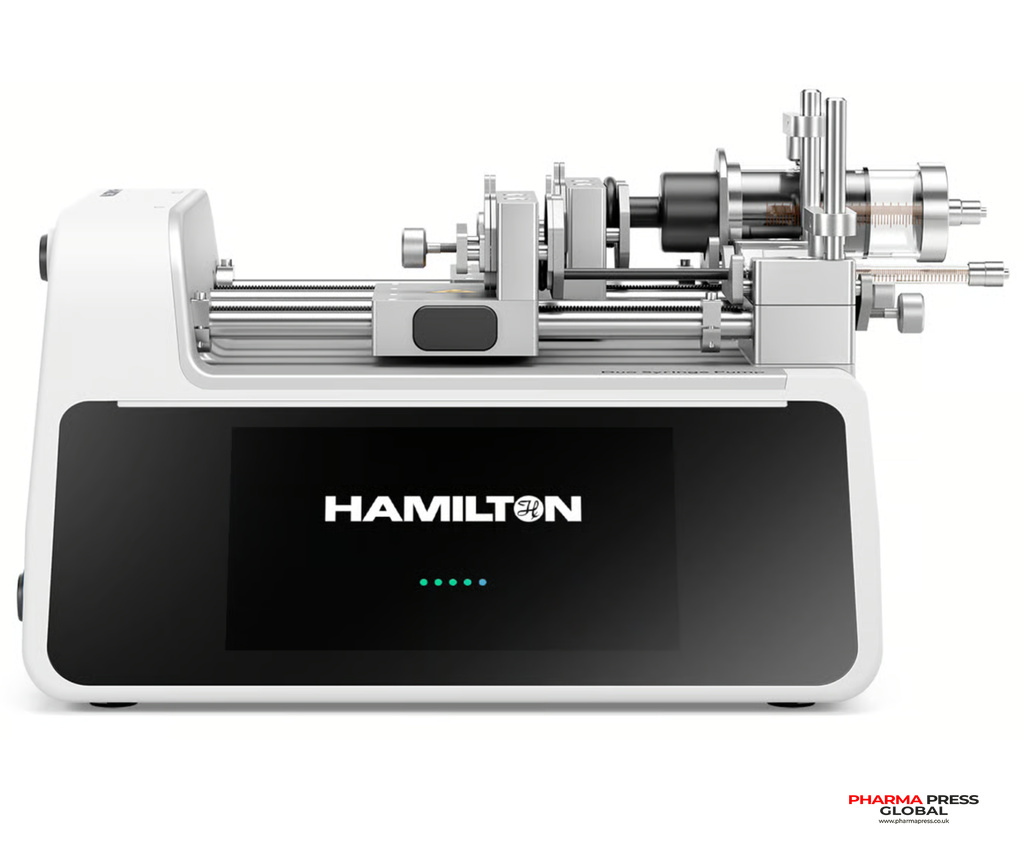
Hamilton announces the launch of the Duo Syringe Pump a new benchtop syringe pump designed for research applications that require independent control, reproducible liquid delivery, and adaptable fluidic configurations.
The Duo Syringe Pump combines two independently controlled syringe drives with an integrated touchscreen. The interface simplifies channel configuration, syringe selection, flow parameters, and method setup, while real-time monitoring provides a clear overview of channel status, delivered volume, and process progress. Saved methods and independent LED status indicators further support efficient, repeatable operation.
Designed to make complex workflows easier to control
Designed to provide stable, low-pulsation liquid delivery even at low flow rates, the Duo Syringe Pump features interchangeable single- and dual-syringe holders for greater application flexibility. Each drive can operate a single syringe independently, while the dual-syringe holder enables two matched syringes to move simultaneously.
The interchangeable syringe holders enable one, two, three, or four-syringe configurations, allowing the syringe pump to adapt to different requirements. Optimised for Hamilton precision syringes, the pump supports syringe volumes from 0.5 μL to 50 mL, while selected third-party syringes can also be used if they meet the required compatibility specifications.
The Duo Syringe Pump can be positioned horizontally or vertically to fit different laboratory environments. Optional accessories, including a solenoid valve with pressure sensor, bubble sensor, and additional syringe holder configurations, extend the syringe pump for advanced fluidic control and greater process visibility.
The Duo Syringe Pump is designed to support research workflows across academia and life sciences, analytical chemistry, microfluidics and organ-on-chip research, chemical synthesis, materials research and preclinical and physiological research.
Applications include reagent delivery, controlled dilution, direct infusion, sampling, microfluidic flow control, parallel delivery of two liquids and continuous or multi-step liquid-delivery workflows.